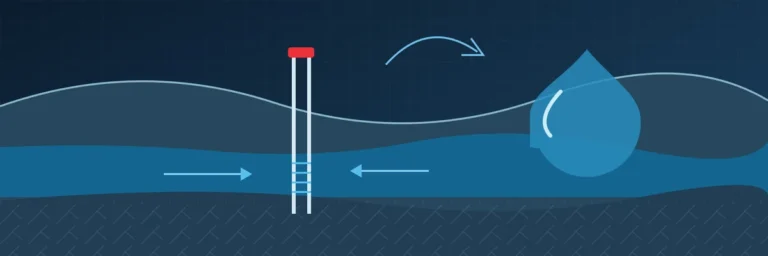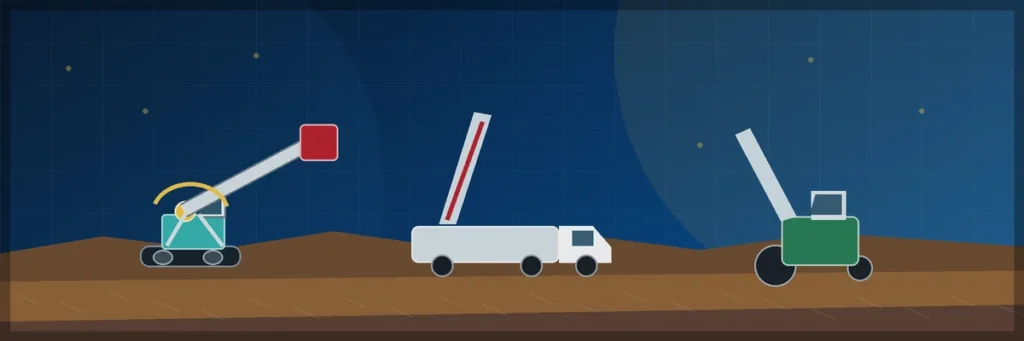
A rig can be classified in two different ways
People often mix the drilling method with the mounting platform. “DTH rig” describes how rock is broken, while “crawler-mounted rig” describes how the machine moves. A crawler can be configured for DTH, rotary or combined work.
Rig types by drilling method
The methods below are used across water-well, geotechnical and related drilling. Their suitability depends on geology, required samples, diameter, depth, environmental controls and available support equipment.
Down-the-hole percussion
A pneumatic hammer operates behind the bit while the drill string rotates. Compressed air powers the hammer and carries cuttings upward. DTH is widely considered for competent rock and can provide clear indications from cuttings and water entry.
- Strong fit: competent and fractured rock
- Support: high-pressure compressed air, hammer, bits and lubrication
- Watch: overburden stability, dust, water inflow and compressor matching
Direct-circulation rotary
A rotating bit cuts the formation while drilling fluid or air travels down the drill string and returns up the annulus with cuttings. Fluid-supported rotary techniques can help stabilise loose formations.
- Strong fit: many unconsolidated or mixed formations
- Support: mud pump, tanks or pits, mixing and cleaning equipment
- Watch: fluid properties, losses, disposal and borehole development
Reverse-circulation rotary
Circulation is reversed so cuttings return inside the drill pipe. The method can support efficient removal from larger holes when the rig, pump or air-lift system and formation are suitable.
- Strong fit: project-specific larger-diameter or high-output work
- Support: dual-wall or suitable drill string and high circulation capacity
- Watch: mobilisation scale, water demand, hole control and equipment cost
Cable-tool drilling
A heavy tool string repeatedly lifts and drops to break the formation, with cuttings removed by a bailer. It can work with temporary casing and gives direct control, but production is often slower than modern rotary methods.
- Strong fit: selected formations and projects where casing follows the tool
- Support: tool string, jars, bailer and casing equipment
- Watch: drilling rate, tool handling and availability of experienced crews
Auger drilling
Helical flights carry cuttings to the surface. Solid- or hollow-stem augers are typically used for relatively shallow work in suitable unconsolidated ground, environmental wells or investigation holes.
- Strong fit: shallow, accessible, cohesive or partly stable formations
- Support: auger flights, bits, centralisers and extraction capacity
- Watch: depth, cobbles, saturated loose ground and hole stability
Sonic drilling
High-frequency vibration advances casing and tooling with comparatively continuous samples in many formations. It can be valuable for investigation and environmental work but requires specialised equipment and skills.
- Strong fit: high-quality sampling and difficult mixed overburden in suitable projects
- Support: sonic head, casing system and specialised tooling
- Watch: capital cost, availability, depth and production-water economics
Rig types by carrier or mounting
The mounting determines transport, site access, setup and stability. It does not by itself determine drilling capability.
| Carrier | Where it can fit | Advantages to evaluate | Constraints to evaluate |
|---|---|---|---|
| Crawler-mounted | Rough ground, soft sites, repeated movement within a project area | Traction, low-speed positioning, compact setup and platform stability | Low road speed, transport permit, track wear, mass and recovery from weak ground |
| Truck-mounted | Frequent road mobilisation and sites with suitable access | Integrated road transport, fast setup and onboard storage options | Axle loads, height and width, stabiliser reactions, turning radius and off-road limitations |
| Tractor-mounted | Regional work where tractors, operators and service networks are available | Familiar carrier, potential off-road mobility and local service access | Power integration, road speed, braking, stability, load distribution and auxiliary equipment |
| Trailer-mounted | Controlled access, smaller packages or shared towing assets | Separate tow vehicle and potentially lower dedicated carrier cost | Towing capacity, braking, drawbar load, setup, levelling and site recovery |
| Skid-mounted | Fixed, restricted or modular installations; transport by truck or lifting equipment | Simple base, modular package and flexible transport arrangement | Requires lifting/haulage plan, setup foundation and separate site movement system |
| Portable or modular | Restricted-access investigation and small-diameter work | Components can be moved separately into difficult locations | Lower capacity, more assembly, manual handling and limited production range |
Synergy Rigs Africa presents water-well drilling rigs and tractor-mounted rig options; suitability still needs to be checked against the project duty.
The same borehole may need more than one method
A typical hard-rock site can have loose soil and weathered material above competent bedrock. The crew may use a rotary bit, temporary casing or an overburden system through the upper zone, then change to DTH once the hole is stable in rock.
In fractured or cavernous rock, air loss, water inflow or collapse can force another change. A method statement should define the likely transitions and the equipment needed to recover or case the hole.
Applications and likely rig characteristics
Application names do not automatically select a model. They help define the hole, mobility, verification and production requirements.
Domestic and small-property supply
Often prioritises compact access, controlled disturbance and a completion matched to moderate demand. The project still needs proper siting, construction, development, testing and sanitary protection.
Agriculture and livestock
Demand, pumping hours, storage and seasonal use can require a larger tested duty. Access across farms, irrigation layout, power choice and long-term maintenance influence the rig and completion.
Community and institutional water
Professional supervision, traceable materials, formal pumping tests, water-quality controls and resilient pump systems are important because many users depend on one source.
Commercial and industrial use
The water duty, quality limits, redundancy, treatment, metering and operating records may be more demanding. The borehole must be integrated with storage and site utilities.
Exploration or monitoring
Sample quality, contamination control, precise completion intervals and documented development may be more important than production rate. Specialised auger, rotary or sonic systems may be considered.
Deep or difficult formations
Rig pullback, rod handling, circulation capacity, casing plan and recovery margin become critical. Review the depth factors rather than relying on a generic deep-rig label.
A practical method comparison
This high-level matrix highlights the main decision variables. A hydrogeologist and competent driller should confirm the programme for the actual site.
| Method | Rock-breaking action | Cuttings return | Typical strength | Key limitation |
|---|---|---|---|---|
| DTH percussion | Impact at the bit plus rotation | Compressed air, sometimes with water or foam | Efficient hard-rock drilling with short energy path | Needs matched air; loose upper ground and large inflows can complicate drilling |
| Fluid rotary | Continuous rotary cutting | Drilling fluid returns through annulus | Hole support and cuttings transport in many loose formations | Fluid management, formation damage, losses and development effort |
| Air rotary | Continuous rotary cutting | Compressed air returns through annulus | Fast clean-out in suitable stable formations | Dust, noise, air demand and reduced control in unstable ground |
| Reverse circulation | Rotary cutting; system varies | Cuttings return inside drill pipe | High-capacity cuttings removal and larger-hole potential | Large, specialised support package and site logistics |
| Cable tool | Repeated lifting and impact | Bailer removes cuttings | Incremental control and ability to advance casing in selected ground | Slower production and specialised tool-handling skills |
| Auger | Rotating helical cutting | Flights carry cuttings | Simple shallow drilling in suitable materials | Limited by depth, boulders and unstable saturated formations |
How to choose from the rig types
Work through the sequence below before comparing prices or model names.
Describe the geology
Use regional records and a professional siting assessment to define likely overburden, rock, fractures, cavities, water levels and quality risks.
Define the finished borehole
State total target, diameter profile, casing, screen, filter pack, sanitary seal and pump requirements. Drilling is selected to deliver this completion.
Select the primary method
Choose the breaking and circulation approach for the most important formations, including a plan for unstable upper ground.
Select the carrier
Match road travel, terrain, access dimensions, setup space, ground capacity and recovery arrangements.
Complete the support package
List compressor or mud system, rods, tools, casing handling, testing instruments, safety equipment and spares. Use the complete equipment checklist.
Verify evidence
Review performance at the required diameter and depth, request configuration drawings and inspect or demonstrate the system under representative conditions.
Frequently asked questions
Rig classification is useful only when it is connected to a defined drilling duty.
What is the most common rig for hard-rock water boreholes?
DTH-capable rotary rigs are commonly considered for competent rock, provided the compressor, hammer, bit, rods and cuttings-return path are correctly matched. Overburden may require a separate technique.
Is a crawler rig more powerful than a truck-mounted rig?
Not necessarily. The carrier describes mobility. Drilling power depends on the installed rotation head, feed, pullback, mast, power unit and support systems.
Can a mud rotary rig drill rock?
Rotary systems can drill many rock types with suitable bits, torque, weight and circulation, but the practical rate and cost depend on the formation. DTH may be more attractive in competent hard rock.
Why use reverse circulation?
Reverse circulation can move a large volume of cuttings inside the drill string and is considered for certain large-diameter, deep or high-production holes. It requires a specialised and well-matched system.
Which rig is easiest to transport?
That depends on legal road dimensions, mass, axle loading, haulage availability, route condition and the support equipment. Compare the whole convoy and setup—not the rig alone.
Planning equipment for this work? Share the location, depth, diameter and ground conditions and we will propose a matched rig package.